Why McGill University is coming to Luxembourg: €8.3 trillion funds to manage

Updated: 4 days ago
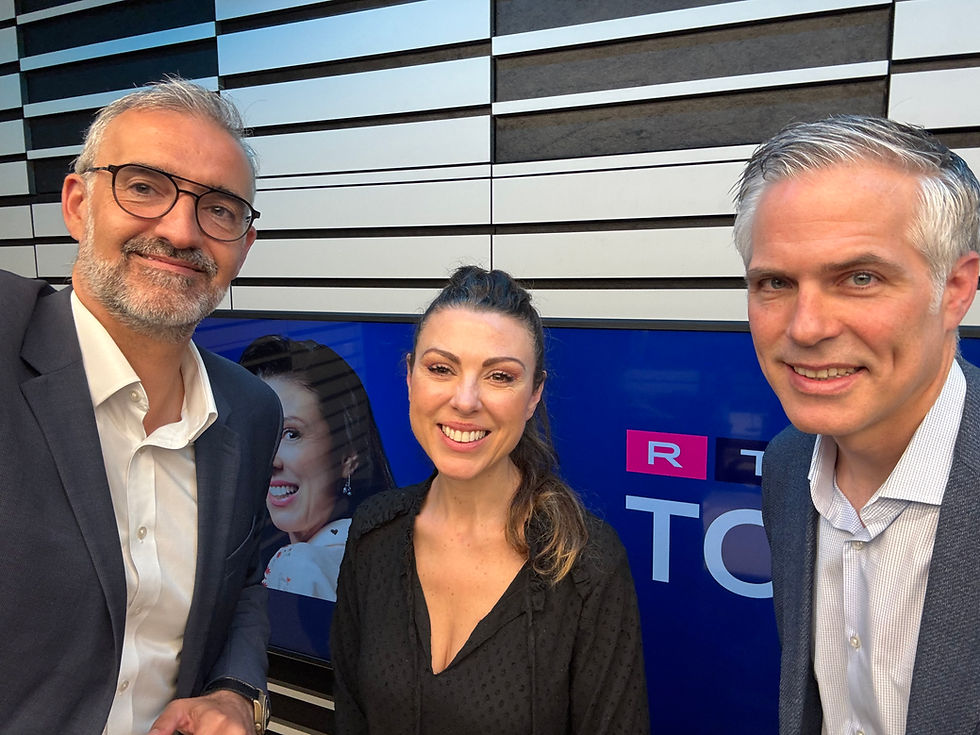
McGill University is coming to Luxembourg at a defining moment for European finance. With €8.3 trillion in fund assets under management, Luxembourg has capital and regulation. Now it needs talent, financial education and a bigger conversation about Europe’s savings, pensions and future competitiveness. ALFI’s Serge Weyland and McGill’s Patrick Augustin explain why talent, pensions and financial literacy matter now.
Why McGill University is coming to Luxembourg, and why it matters
McGill University is coming to Luxembourg. At first glance, that may sound like a story about higher education. In reality, it is a story about money, talent, Europe’s future competitiveness and one of the most urgent personal questions: why are so many of us never taught how to handle our own finances?
On this episode of The Lisa Burke Show, I sat down with two guests who understand the story from the inside: Serge Weyland is CEO of ALFI, the Association of the Luxembourg Fund Industry; Patrick Augustin is Associate Professor of Finance at McGill University and Director of the new McGill Luxembourg Centre for Finance. Together, they told the story of how Luxembourg became one of the world’s great fund centres, why that success now depends on people, and why financial literacy may be one of the most important lessons Europe can teach.
Luxembourg’s finance story is astonishing. The country is now home to around €8.3 trillion in fund assets under management. That number is so large it almost becomes abstract, but its importance is very real. The financial services sector employs around 50,000 people in Luxembourg, with roughly two thirds of them working in the fund industry. Financial services also represent around a quarter of the country’s GDP.
“Luxembourg today is home to 8.3 trillion. So that’s a lot of money.” Serge Weyland, CEO of ALFI
Serge traced the story back to 1988, when Luxembourg became the first EU Member State to transpose the European UCITS Directive into national law. In plain English, this created the famous “fund passport”, allowing an investment fund created in one EU country to be sold across the others. That foresight helped Luxembourg attract major global asset managers and become a leading centre for cross-border fund distribution.
It is one of Europe’s quietest success stories. At a time when the single market is often criticised for being slow or incomplete, the European fund passport shows what can happen when policy, regulation and commercial opportunity align. Serge described it as one of Europe’s great commercial successes, and one that deserves to be better understood.
But money alone is not enough. Patrick’s central point was that the future of finance depends on people.
“Talent is the infrastructure of the financial industry. If you don’t have good talent, you’re at the risk of failing in the longer run.” Patrick Augustin, McGill University
That is the gap McGill has come to fill. The new McGill Luxembourg Centre for Finance is a joint initiative involving McGill University, the Ministry of Finance, ABBL and ALFI. Its flagship programme is a two year, part time Master of Management in Finance, taught in Luxembourg on weekends by McGill faculty.
What makes the programme stand out is its practical core. Students manage a real, regulated fund through Desautels Capital Management. They do the compliance, execute trades, produce reports and defend their investment ideas to outside investors. Patrick explained the value of this with a beautifully simple analogy: if you wanted to learn tennis or the piano, would you watch videos, or would you play?
That question gets to the heart of modern education. In a world of AI, automation, tokenisation, digital assets and private equity, people need more than theory. They need judgement, confidence and direct contact with the industries they hope to enter. Luxembourg’s advantage is its unusually close ecosystem, where academia, industry and policymakers can speak to each other directly.
“The secret sauce is the closely knit community. When there is a need for the industry, we know we have a direct line into the legislator.” Serge Weyland
The conversation then moved from the world of global funds to something far more personal: pensions. Europe has a demographic challenge, and Luxembourg is part of it. More retirees, fewer workers and rising pressure on public systems mean that the way we save, invest and prepare for later life has to change.
A joint ALFI and McGill study looked at how Europeans save, and the findings are striking. European households hold roughly €14 trillion in cash and savings. That represents around 41 to 42 percent of household savings, compared with roughly 14 percent in the United States. Cash can feel safe, but over time inflation quietly erodes its value.
The study also looked at what could happen if major European economies reformed their pension systems. If France and Germany alone moved closer to the models used in Sweden or Denmark, they could unlock an additional €10 trillion over time. Sweden, Serge noted, went from funded pensions worth around 12 percent of GDP twenty years ago to around 120 percent today.
Serge said that after 40 years in finance, if he had invested regularly from the beginning of his career, he believes he would have five or six times the money he has today. Why did he not do it? Because no one taught him.
“Personal finance essentials should be mandatory, bottom up, from an early age, of course in an age appropriate way.” Patrick Augustin
Financial literacy is often treated as a specialist subject, something for bankers, investors or people who already have money. But the truth is that everyone needs to understand saving, investing, risk, inflation, pensions and compounding. These are life skills.
As markets evolve, the barrier to entry may also fall. Serge spoke about tokenisation and fractional fund units, where people could invest smaller amounts, perhaps €30, €40 or €50 a month, through digital wallets and lower cost platforms. The technology is still developing in Europe, but in parts of Asia this kind of access is already becoming more common.
Of course, digital finance brings risks too. Crypto, stablecoins, the digital euro, tokenised funds and new trading platforms each deserve their own careful conversation. But one message was clear: the more accessible finance becomes, the more urgent financial education becomes.
Luxembourg has built something extraordinary. It has capital, regulation, expertise and a global reputation. The next question is whether it can build, attract and retain the talent to match. With McGill arriving in Luxembourg, and with ALFI pushing hard on education, research and industry collaboration, the country has a chance to shape the next chapter of European finance.
Watch the full episode on RTL Play, listen on RTL Today Radio, Apple Podcasts or Spotify, and subscribe for more conversations on finance, science, education, technology and the future of Europe.
Links and further reading
Contact the MMF Luxembourg programme: mmfluxembourg@mcgill.ca
ALFI investment in higher education


Comments