European Young Farmers

Updated: Jul 24
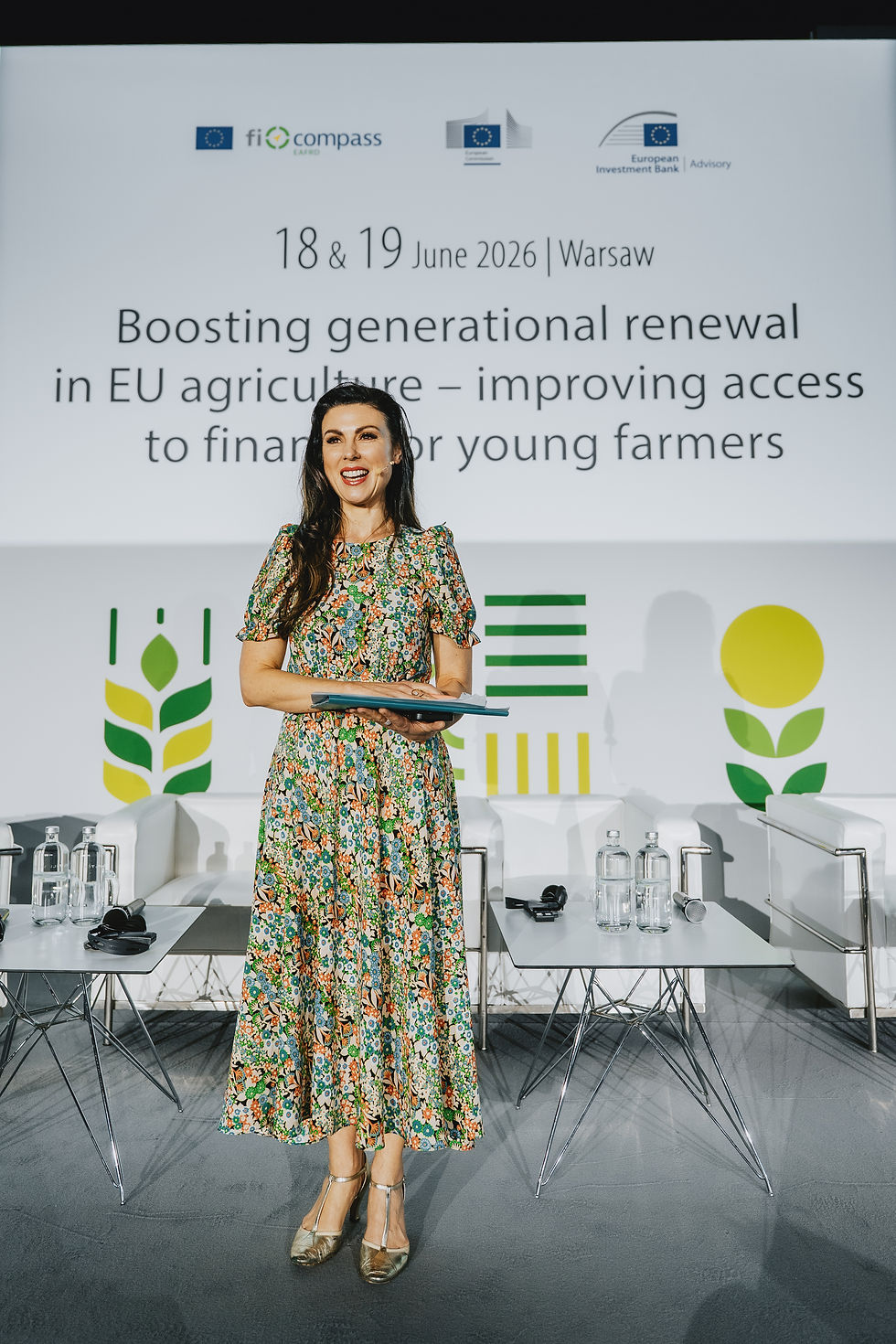
In June 2026, the European Commission [DG Agri] and the European Investment Bank Group [FI-Compass] convened a conference in Warsaw, Poland with a focus on the Young Farmers of Europe.
Why Poland? One quarter of EU Young Farmers are Polish.
Farming is a beautiful but tough vocation, often running through family lines, making it hard for new people to enter. Climate change is also having an effect on the land, risk assessments and planning. These are just a couple of the myriad considerations as to why the current average age of a farmer in Europe is 57 and only 12% of our farmers are under 40, only 1 in 30 of these are female (although many farms are run by a couple). This is a problem.
Anna Czerniecka co-runs a family farm in Poland. Łukasz Łęgowski built his own operation in the country's north. Sebastian Stens is preparing to take over his parents' organic farm in Saxony-Anhalt, Germany. Andrea De Marchi is growing his family's holding in northern Italy. This June, all four stood in a conference room in Warsaw in front of EU officials, bankers and ministers, and explained, in plain terms [dotted with wonderful photos of their wedding and children on tractors and haystacks] what it actually takes to get a bank to say yes to a young farmer.
Europe's ability to grow its own food is starting to slip within a generation. That was the backdrop for Boosting generational renewal in EU agriculture.
The young farmers who spoke stood at the heart of all that was discussed and their situations are all different, which was the point. Anna's family farm has been built up over years, and she spoke eloquently about what it takes to keep investing in it rather than just keeping it standing still. Łukasz talked about choosing a local bank as a business partner early on, and the sheer weight of paperwork that comes with running a small farm. Sebastian is mid handover, working alongside his father and studying agricultural science so he can take the farm fully organic and future proof it. Andrea walked through the practical reality of expanding a family holding in Italy, how land actually gets bought, and how young Italians without deep pockets or existing collateral do it at all.
None of these farmers asked for a handout. They asked for financing authorities to understand, deeply, how a farm actually makes money.
Here's the problem in plain terms. Farming needs big upfront money: for land, machinery, livestock, buildings. But a farm's income arrives once or twice a year, at harvest, and a young farmer usually doesn't own much a bank can seize if something goes wrong. To most banks, that combination looks risky. Roughly a third of young farmers across the EU have no assets they can put up as collateral, and about a quarter say they're too afraid of rejection to even apply for a loan. That gap, more than land prices or paperwork, is what's actually pushing people away from farming.
How the money actually works
So what's changing? The short version: instead of asking a bank to carry all the risk of lending to a 28 year old with no collateral, the EU and national development banks now agree to absorb a share of the loss if the loan goes bad. That's called a guarantee. It doesn't hand a farmer cash directly. It just makes a bank far more willing to say yes, because the bank isn't carrying the full risk alone.
A guarantee doesn't put money in a farmer's pocket. It puts a bank's fear on the balance sheet instead of the farmer's.
You can see this playing out differently in almost every country. In Poland, BGK, the state development bank, launched Agromax, a guarantee that covers up to 80% of a farm loan. Young farmers can also get a top up subsidy covering up to 100% of their interest payments for the first two years, effectively stacking a guarantee on top of a grant so the loan gets both safer for the bank and cheaper for the farmer. That stacking is what people in this world call blended finance. It sounds technical. In practice it just means combining public support so a bank's caution and a farmer's newness both stop being dealbreakers.
In Germany, Rentenbank runs Wachstum, which gives farmers under 41 a lower interest rate simply for being young, on top of financing up to 100% of an investment.
In Ireland, the Strategic Banking Corporation of Ireland offers its Growth and Sustainability Loan Scheme with no collateral requirement at all, which is almost unheard of in agricultural lending.
Italy takes the most direct approach: through Generazione Terra, the state itself buys the farmland a young farmer wants, then leases it to them for up to 30 years while they pay it off, effectively removing the single biggest barrier to entry, the upfront cost of land.
Latvia does something similar through ALTUM's Land Fund, which buys up unused or abandoned farmland and makes it available for new farmers to rent or eventually buy.
France pairs low interest loans through Crédit Agricole with a national scheme called INAF, so a young farmer can combine a soft loan with public backing rather than facing a single all or nothing bank decision.

None of this happens by accident. Someone has to design these products, connect national banks with EU money, and make sure a guarantee scheme in Latvia and one in Ireland actually hold up the same way underneath. That's the job of fi-compass, an advisory service run jointly by the European Commission and the European Investment Bank. Its head, Bruno Robino, and his colleague Frank Lee, spent much of the Warsaw conference walking bankers and civil servants through exactly this: the mechanics of building a loan product a bank will actually offer and a young farmer will actually qualify for.
The political backdrop is that the EU wants member states to set aside at least 6% of their farm budgets specifically for this over the next few years, a target Commissioner Christophe Hansen has pushed hard, alongside EIB Vice-President Gelsomina Vigliotti and Kerstin Rosenow from the Commission's agriculture team.
Groups like CEJA, representing Europe's young farmers, and COPA-COGECA, representing farmers and their cooperatives, are pushing to make sure that target survives contact with national budgets rather than becoming another unfunded promise.
But the reason any of that matters is Anna, Łukasz, Sebastian and Andrea, and the thousands of young Europeans like them deciding, right now, whether farming is a future they can actually afford to choose. The mechanics matter because the alternative is simple. If the money doesn't reach them, they don't farm, and someone else grows Europe's food, or nobody does.

I wanted to give a particular mention to all of the wonderful interpreters at these events. They have such a great skill - often firstly interpreting the meaning of a speaker (who might not be speaking in their mother tongue) and then translating this into multiple other languages with the inherent, interpreted, message.
Sources and further reading:
Conference details, Boosting generational renewal in EU agriculture: https://events.fi-compass.eu/event/young-farmers-finance-warsaw-2026/about-the-conference fi-compass: https://www.fi-compass.eu/
EU Strategy for Generational Renewal in Agriculture: https://agriculture.ec.europa.eu/overview-vision-agriculture-food/generational-renewal_en
BGK Agromax guarantee, Poland: https://www.bgk.pl/produkty/gwarancja-agromax/
Rentenbank Wachstum programme, Germany: https://www.rentenbank.de/programmkredite/landwirtschaft/wachstum/
SBCI Growth and Sustainability Loan Scheme, Ireland: https://sbci.gov.ie/products/growth-and-sustainability-loan-scheme
ISMEA Generazione Terra, Italy: https://www.ismea.it/Startup/GenerazioneTerra
ALTUM Land Fund for new farmers, Latvia: https://www.altum.lv/en/services/land-fund-of-latvia/land-for-the-new-generation-of-farmers/
CEJA, European Council of Young Farmers: https://www.ceja.eu/
COPA-COGECA: https://copa-cogeca.eu/
Comments