Western Balkans EU Enlargement: How Long Can Europe Keep Its Neighbours Waiting?

Updated: 4 days ago
Europe has a hole in its own map.
Albania, Bosnia & Herzegovina, Kosovo, Montenegro, North Macedonia and Serbia sit inside the geographical embrace of the European Union, surrounded almost entirely by EU and NATO members. In 2003, Europe promised the Western Balkans a European future.
More than two decades later, the waiting room remains open.
North Macedonia became an EU candidate in 2005. Accession negotiations formally began in 2022, yet the country has still been unable to open its first negotiating cluster. At some point, the waiting has become a political message of its own.
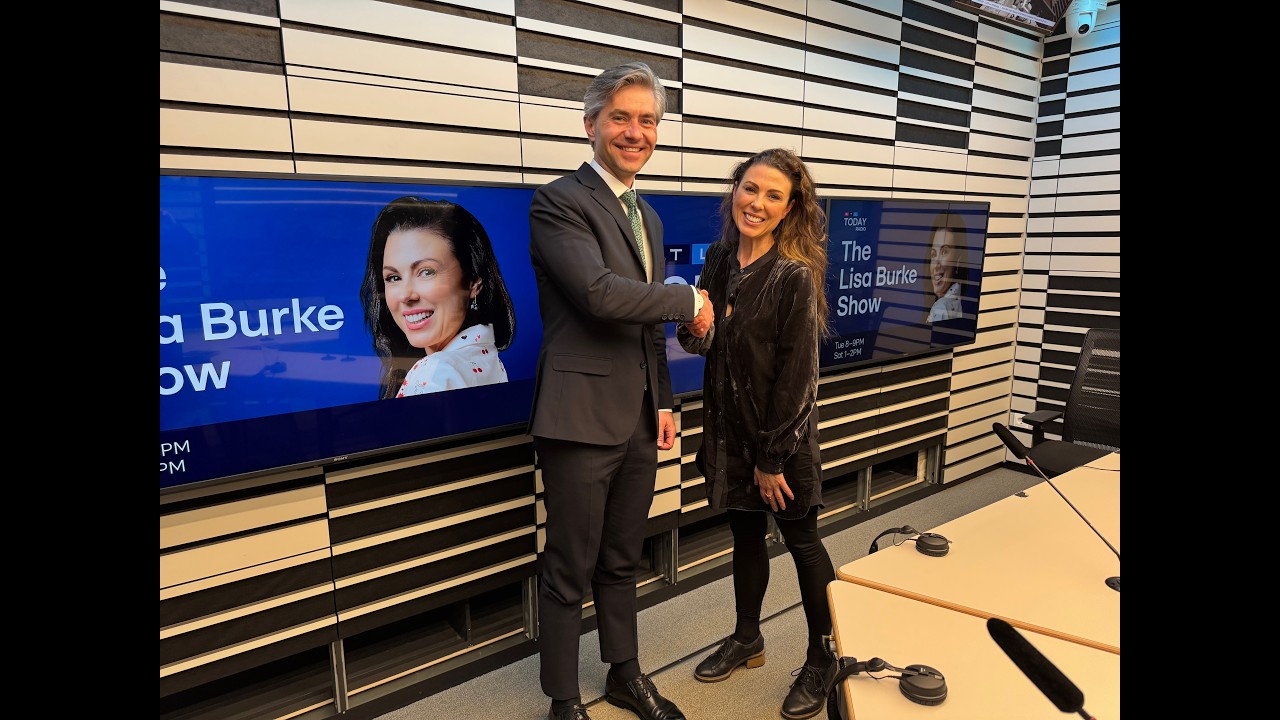
Around my studio table:
Zoran Dimitrovski is North Macedonia’s Deputy Minister of Foreign Affairs and Foreign Trade. Before entering government, he spent 35 years in journalism, editing leading newspapers, reporting from Washington and teaching critical thinking, investigative journalism and analytical writing.
Linas Kojala is CEO of Lithuania’s Geopolitics and Security Studies Center and teaches at Vilnius University’s Institute of International Relations and Political Science. He is also a fellow at the Foreign Policy Research Institute and has studied at Oxford, Cambridge and Harvard. (TSPMI)
One guest comes from a country still waiting to enter. The other comes from Lithuania, a country transformed by joining the European Union in 2004.
Five messages worth carrying away
Twenty one years changes a population. A teenager when North Macedonia became a candidate could now be approaching 40. Faith in political promises cannot survive indefinitely without visible movement.
Europe’s veto system gives bilateral disputes continental consequences. One member state can delay another country at critical points in the accession process.
Membership must retain standards. Judicial reform, democratic institutions, the rule of law and the fight against corruption remain essential. A credible process requires credible reform.
Infrastructure has become security policy. Railways, bridges, roads, energy networks and digital systems determine how people, goods and military equipment can move across Europe.
A political vacuum attracts attention. Prolonged uncertainty gives Russia, China and other external powers more space to exert economic, political and informational influence.
Twenty one years at the front door
North Macedonia’s path has been shaped by a succession of obstacles.
The long dispute with Greece over the country’s name was resolved through the Prespa Agreement. The country adopted the name North Macedonia and joined NATO in 2020.
Then came the dispute with Bulgaria, touching some of the most sensitive elements of nationhood: language, history, identity and the constitutional recognition of the Bulgarian community in North Macedonia.
Dimitrovski accepts that his country has considerable work ahead. Laws must align with the EU acquis. Corruption must be confronted. The judiciary must become stronger and more independent.
His frustration lies in the belief that the decisive block has emerged from bilateral arguments which reach beyond the usual accession criteria.
“It took us 20 years, and now a 21st year, to wait at the front door just to start negotiations.”Zoran Dimitrovski
“They are asking us to change our identity, to change our history, and to change what we are and who we are.”Zoran Dimitrovski
The European Parliament has called for North Macedonia to adopt the constitutional amendments required to open the first cluster, accelerate reforms and build greater cross party consensus. It has also warned against allowing disputes over language, culture and national identity to obstruct accession. That is the delicate centre of the argument. Standards give membership its value. Fairness gives the European promise its credibility.
Twenty seven countries choosing a restaurant
Kojala offered perhaps the most memorable description of the European Union:
“The European Union is the most boring miracle in politics nowadays.”Linas Kojala
Boring, because it operates through an undergrowth of procedures, acronyms, plans and negotiating frameworks. A miracle, because countries carrying centuries of conflict have managed to share laws, markets, institutions and political power.
He compared EU decision making to 27 friends attempting to choose a restaurant. Except they may not all be friends, and the decisions concern sovereignty, security and billions of euros.
The joke lands because everyone understands the agony of a group chat. The geopolitical version is rather more serious.
“Some of the things that we introduced 20 years ago are not adequate today.”Linas Kojala
Europe’s enlargement machinery was built for a different political climate. Today it must operate amid war in Ukraine, cyberattacks, sabotage, foreign interference, disinformation and a global contest for influence.
A system designed for caution may now be producing strategic exposure.
A bridge can be a security policy
EU enlargement sounds abstract until somebody asks whether a bridge can carry a military vehicle.
Dimitrovski pointed to Corridors VIII and X, routes crossing North Macedonia and connecting the Adriatic, Black and Aegean Seas with the rest of Europe. They matter for trade, jobs, tourism and everyday travel. They also matter for NATO mobility and Europe’s ability to respond to a crisis.
“It is very important that Europe builds these corridors. They are important for the mobility of forces from the Adriatic to the Black Sea and from Eastern Europe to the Aegean Sea.”Zoran Dimitrovski
A delayed railway is therefore more than a delayed railway. It can expose a commercial weakness, a regional inequality and a security vulnerability at the same time.
The European Commission’s Growth Plan for the Western Balkans offers €6 billion in grants and loans linked to reforms and economic integration. Meanwhile, the European Court of Auditors has examined whether EU investment across the region is delivering effectively. Money matters. Implementation matters just as much. (Enlargement and Eastern Neighbourhood)
Vacuums acquire occupants
Russia retains political and media influence in parts of Serbia and Bosnia and Herzegovina. Chinese investment has expanded through infrastructure, lending and strategic commercial projects.
Dimitrovski did not suggest that the entire region is about to swivel towards Moscow or Beijing. His warning was quieter and, perhaps, more worrying.
Years of uncertainty can weaken institutions, exhaust reformers and leave frustrated populations more exposed to financial pressure, political manipulation and manufactured narratives.
“If we are waiting too long, this region may become an unstable political region and, in the future, a security unstable region.”Zoran Dimitrovski
Kojala’s answer was to remember the principle of solidarity embedded within the European project:
“We have our own national interests, but there are higher goals.”Linas Kojala
The quotations in this post are drawn from the programme transcript.
So, how long is too long?
The Western Balkans cannot be waved into the European Union because the geopolitical weather has turned ugly. Reform must be real, lasting and measurable.
Europe also has obligations of its own. The conditions must be clear. Progress must produce tangible rewards. Bilateral disagreements should not become an endless supply of new locks for an already crowded door.
A permanent waiting room eventually changes everyone inside it. It also changes the institution that keeps calling their name without allowing them through.
The EU is, as Kojala says, a boring miracle. Miracles still require maintenance.
How long can a promise remain credible before patience begins to feel like rejection? But also, what risks can Europe handle?
Watch or listen to the full conversation
This episode of The Lisa Burke Show is available here:

Comments