The State of the Environment in Europe

Updated: Sep 27
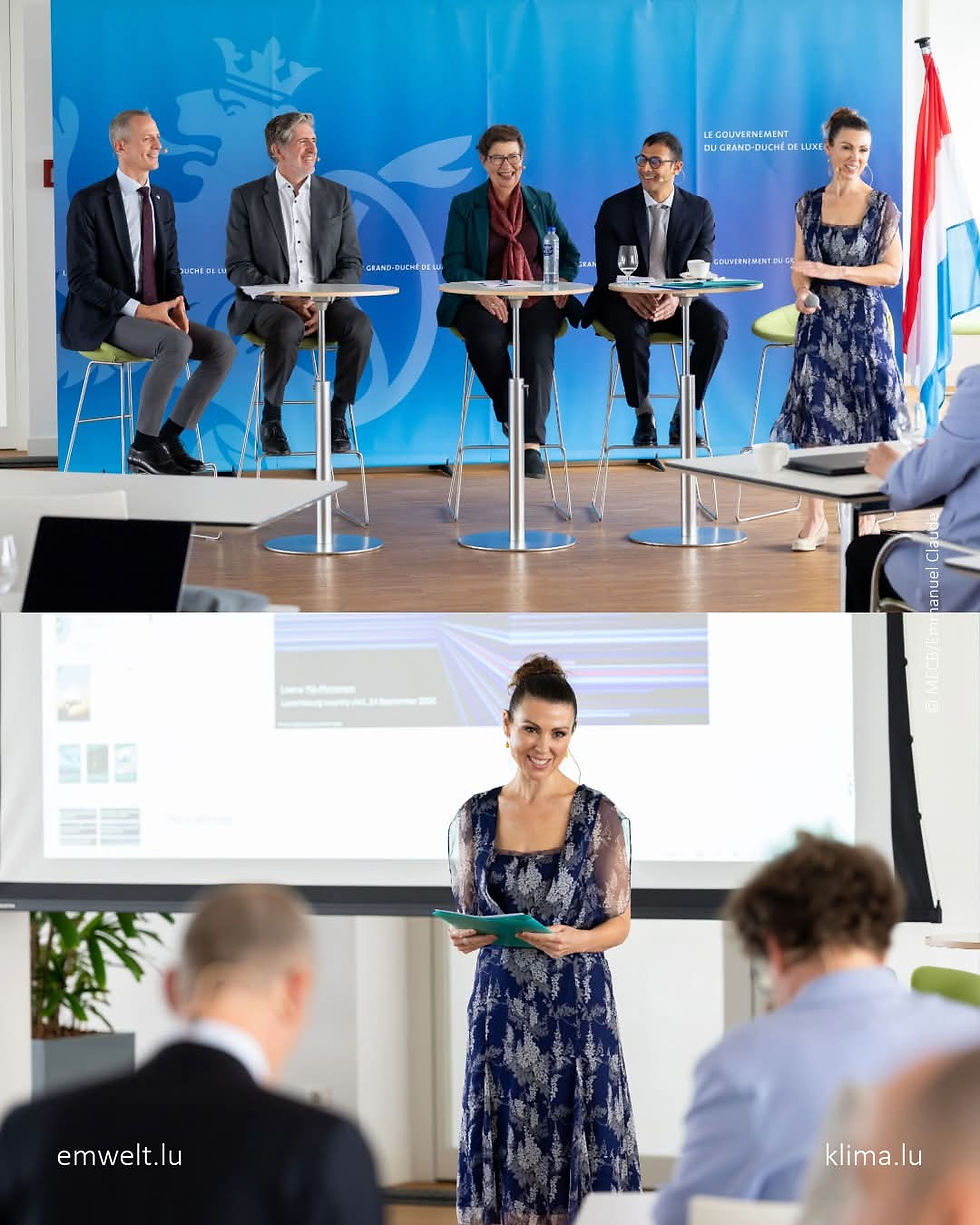
For the first time ever, the European Environment Agency came to Luxembourg, and I had the privilege of moderating the morning event, including a discussion on how we translate scientific evidence into effective policy, and into something ordinary people actually care about.
A continent-sized knowledge machine
EEA Executive Director Leena Ylä-Mononen and Head of Communications Katja Rosenbohm opened by showing us the scale of the operation behind Europe's environmental data. It's a network of around 500 institutions, including 27 EIONET groups (the European Environment Information and Observation Network) made up of 3,500 experts. Together they produced the 2025 European Environment Report.
This data can take years to gather, verify and collate. The type of data to be collected, and invested in, is also a decision and often one for the future. But this data becomes the foundation for the policy and socio-economic levers that shape how we live, work, build and travel.
"People don't experience a graph"
Minister of Environment, Climate and Biodiversity Serge Wilmes focussed on how we reach normal people in a way to effect changing behaviours: people don't experience a graph.
A line trending upwards on a chart rarely changes behaviour. How do we translate numbers into narrative that hits the heart? What changes behaviour is when scientific information becomes a household value: the cost of your energy bill, the quality of the air your children breathe, whether your garden survives another dry summer.
Katja urged the need to deepen our cultural bond with nature and build a shared set of core values around it. We fundamentally depend on land, water and air; energy in all its forms, kinetic, solar and chemical; soil, with its biodiversity and nutrients; minerals and metals; and our ability to adapt and stay resilient as the climate changes.
The human cost: Pollution and Premature Deaths
According to the World Health Organization and the United Nations, pollution is linked to around 10% of premature deaths globally.
We all understand how fragile our world is the moment we face it directly: water scarcity, forest fires, or illness caused by the air we breathe. The challenge is helping people understand that fragility before it arrives at their door and what we can do to mitigate it.
It's not all bleak. Greenhouse gas emissions in the EU are falling. The caveat, of course, is that they are still rising globally, and climate is a global problem that no single region can solve alone. But the European trend shows that policy, investment and public will can move the needle.
Do we need a GDP for the planet?
Olivier Thunus of STATEC, Luxembourg's national statistics institute, made a compelling case for a single headline indicator of a country's environmental health, a kind of environmental equivalent to GDP. Economic health has one number everyone recognises; environmental health does not.
Christian Thalacker-Heldenstein pointed out that a similar idea has already been championed by Tenzin Seldon under the banner of Gross Domestic Regeneration. It is a concept I would love to see gain more traction.
Olivier was also candid about a real gap: the link between statistics and policy is not always clear. Which brings us back to the central question of the panel. How do we put knowledge into action?
Disinformation
Umar Dahoo, the French Focal Point for the EEA, has just released a report on disinformation. His findings on where the most disinformation comes from were striking:
Politicians
Journalists
Social media
Umar also shared an approach championed by President Emmanuel Macron for countering untruths. Rather than framing the debate as "this is true, that is not," we shift it to "this is science, this is not."
This subtle shift moves the conversation away from absolute dogma towards a transparency check: what was the methodology, who is accountable, and was a proper scientific process followed?
It invites scrutiny instead of demanding belief.
What we eat matters
On a personal note, I was particularly interested in the EEA's work on protein diversification. Changing how we eat, and how we use and develop agricultural land, is just as important to the environment as how we travel or consume energy. It is one of the most tangible levers any of us can pull at home.
Another red zone for the EU is the circular use of materials. Frankly, we are not doing it well enough. There is a huge opportunity to build a better economy through reuse, and construction materials are just one obvious place to start.
Stewardship of our Earth
It's easy to feel overwhelmed when confronted with the loss of biodiversity, shifting weather patterns, and arid, charred landscapes. I felt it at moments during my reading around this event.
But the message I left with was responsibility.
Data is gathered by thousands of experts across Europe, but turning it into positive change falls to all of us: policymakers, scientists, statisticians, journalists and citizens alike.
We must all become stewards of this world while we are on it.
Lisa BurkeBroadcaster | Presenter | International Moderator lisatoniburke.com
Comments